The migration journey
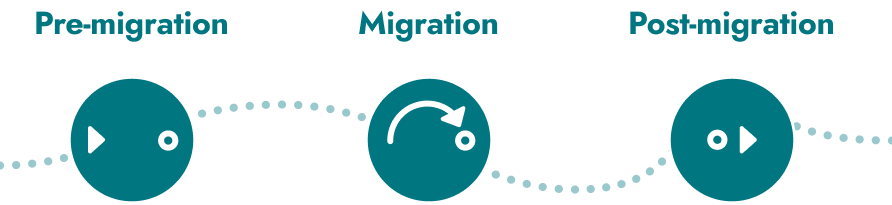
The immigrant and refugee journey is divided into three phases: pre-migration, migration and post-migration. The prevalence of mental health problems and illnesses for immigrants and refugees is largely determined by the protective and risk factors that are experienced throughout each phase of the migration journey (Jaime Ballard, 2019; Farahani, Joubert, Anand, Toikko, & Tavakol, 2021; Carroll, Luzes, Freier, & Bird, 2020).
For example, before and during the migration journey, many refugees experience hardships and traumatic life events that put them at risk for mental health problems and illnesses (WHO, 2021).
Post-migration stressors and the mental health of immigrants and refugees
With Dr. Michaela Hynie (Social Psychologist, Centre for Refugee Studies, York University)
We know that among people who come as economic migrants for example, people who are selected on thebasis of their employment backgrounds and their education backgrounds, people who are selected because they can speak English or French that they are still likely to spendthe first five years living below the poverty line. As many as a quarter of them will be living in poverty. We know that the big barrier for manyof them is the magical Canadian experience, that no matter how good your qualifications, no matter how good your past experience was in the country of origin that you are challenged in termsof finding adequate employment because people are looking for that Canadian experience. It's a way in which we persistently exclude newcomers from accessing employment. With people who are forced migrants, we also know that people access employment through the people that they know. So the more limited your social networks - and social networks are more limited for people who come as forced migrants than voluntary migrants - then it's harder to find ways in to adequate employment. The other kinds of factors that we know impact one's health and mental health include social isolation. Social isolation is one of the dominant factors affecting mental health and is reported by immigrants and refugees as a major concern. We also know that access to adequate housing, access to education and educational pathways are things that have an impact on one's health and well-being and experiences of discrimination or other kinds of exclusion have been shown to have an impact on physical and mental health. Poverty, of course, comes up over and over again and is connected to many of those other determinants.
Actions can be taken at different levels to improve the negative effects of these migration-related experiences. For example:
Pre-migration and migration
Canadian policies on international relations or on admission policies for immigrants and refugees that minimize risk factors and emphasize protective factors of newcomers' mental health can affect immigrants' and refugees' experiences. For instance, policies that emphasize the importance of keeping families together throughout the migration process may act as protective factors for mental health.
Post migration
Directly addressing risk and protective factors, such as the social determinants of health, to support newcomers' mental health.

The next section highlights specific social factors that can impact the mental health of immigrant and refugee populations in the post-migration context in Canada. It is important to note, however, that not all immigrant and refugee subpopulations face the same challenges during resettlement and experience the social determinants in the same way.