Creating an equitable environment
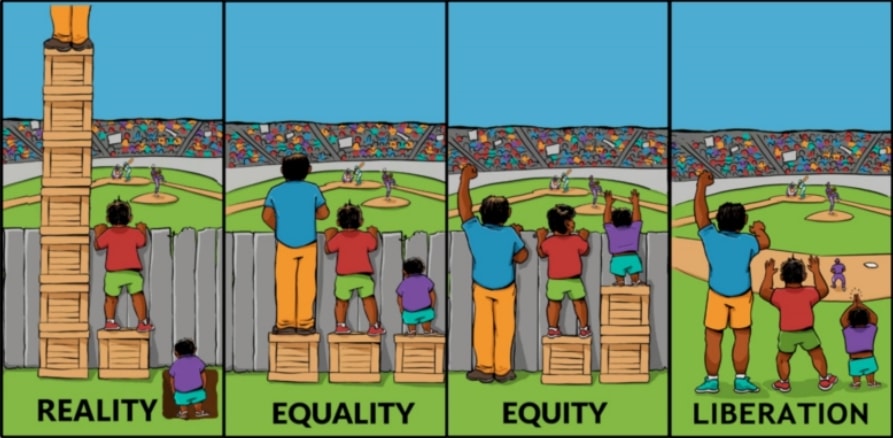 (Interaction Institute for Social Change. Artist: Angus Maguire
Source: Interaction Institute for Social Change: Angus Maguire)
(Interaction Institute for Social Change. Artist: Angus Maguire
Source: Interaction Institute for Social Change: Angus Maguire)
Organizations are comprised of individuals with different characteristics based on age, race, religion, abilities, educational attainment, nationality, and more. Equity in the workplace involves:
-

Fostering equity and diversity in hiring practices to ensure the workforce, at all levels of the organization, reflects the communities that are served by the organization.
-
Ensuring everyone has a fair and equal chance of succeeding.
-
Providing all employees with the unique resources they require to access opportunities in the organization.
-
Recognizing that each staff member has varying access to resources and privileges—those with less access may need more support so they can take fair advantage of opportunities within the organization.
Approaches for creating an equitable and inclusive work environment include:
-

Committing to diversity, equity and inclusion.
-
Promoting a culture of respect and inclusion.
-
Examining and breaking down barriers.
-
Modifying policies and practices.
-
Providing accommodations.
-
Implementing ongoing learning.
-
Keeping the lines of communication open.
-
Reviewing hiring, retention, and promotion practices.
-
Collecting and analyzing data to understand needs and monitor progress.
-
Resourcing and sustaining roles to support internal work.

Practices from the field:
Kamloops Immigrant Services, British Colombia and
Elmwood Community Resource Centre,Manitoba
These organizations are creating equitable and inclusive work environments.
- Read about what Kamloops Immigrant Services is doing
- Read about what Elmwood Community Resource Centre is doing
Racism within organizations
There is a gendered approach to frontline settlement work, and racial hierarchies exist between those delivering direct services and those in leadership positions.
“A 2006 study by the Social Planning Council of Toronto and the Family Service Association reported that over 86 percent of workers in Toronto’s immigrant and refugee seeking sector are women, that 75 percent immigrated to Canada and 63 percent are racialized, addressing the dual phenomena of over representation of women in the sector and the racialization of the settlement sector (Wilson, 2006). An earlier survey of settlement workers across Ontario conducted by the provincial government also found that practitioners are predominantly female (75.9 percent), immigrants (68.7 percent) and university educated (62.7 percent). The majority are bi- or multilingual. This description of frontline workers is in contrast to managerial positions, which tend to be dominated by white women. A 2009 study by The Institute for Governance of Private and Public Organizations and York University found that among 240 organizations, 91 percent of executive directors were white.” (Koltermann & Scott 2018, p. 15-16)
Further evidence demonstrates that racialized women are underrepresented in senior leadership roles and on boards of directors (Cukier et al., 2020).
Racism and violence toward service providers is a serious issue. For example, health care workers of colour, particularly Black and Indigenous health care workers, are at higher risk of experiencing racism and violence in the workplace. Black health care workers are more likely to experience discrimination and racism in the workplace compared to their white counterparts (Thomas et al., 2019). Additionally, Indigenous health care workers experience disproportionately high levels of violence in the workplace (Sow et al., 2016).
This violence can take many forms, including verbal abuse, physical assault and microaggressions.
Microaggressions describes subtle or everyday forms of racism. It refers to veiled instances of racism, homophobia, sexism and other discriminatory behaviour against members of a marginalized group (Henry, 2004). This behaviour can take various forms, including insults, facial expressions, comments and discriminatory gestures. A verbal microaggression can be a comment or question that is hurtful or stigmatizing to a certain marginalized group, such as saying, “You speak English really well” to a person whose native language is English.
Microaggressions are common in the workplace and relate to different intersections (e.g., race, age, gender, and more). Even though the communications may seem too casual on the surface, they are considered a form of racism and discrimination.
Examples of microaggressions include:
- Believing that people of colour are foreigners to Canada
- Considering people of colour as second-class citizens or as less desirable and having distorted cultural values
-
asking prejudiced questions, such as:
- “Where are you really from?”
- “You sound white” or “You’re really well-spoken.”
- “I don’t really see you as Indian.”
- “You have really big eyes for an Asian person.”
Individuals experiencing microaggressions in the workplace may feel anger, pressure and/or hopelessness. Some ethnic minorities express that they feel pressure to “behave white” and suppress their cultural history (Ross et al., 2016).
These experiences can have a significant negative impact on the mental and physical health of health care workers, leading to high turnover rates that can negatively affect the quality of care provided.
It is important for organizations to take proactive steps to address racism and violence in the workplace to ensure the safety and well-being of both staff and clients.